
![]() |
International Indian Treaty Council CONSEJO INTERNACIONAL DE TRATADOS INDIOS |
|||||||
|
|
57th session of the UN Commission on Human Rights 19 March – 27, April, 2001 Agenda item #13: Rights of the Child Written intervention by the International Indian Treaty Council
The International Indian Treaty Council (IITC) commends the Rapporteur of the Committee on the Rights of the Child, Mr. Jaap Doek for his work for full implementation of the Convention on the Rights of the Child (CRC). In his report to the 18th session of the Working Group on Indigenous Populations (E/CN.4/Sub.2/2000/24) Mr. Doek spoke “...of the moral obligation upon the United States (of America) to refrain from taking measures which would negatively affect the situation of Indigenous children in that Country.”
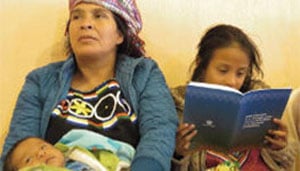
The IITC submits to this body a dismal report of the critical situation for American Indian children living in the U.S. impacted by dire poverty, poor health conditions, environmental contamination and widespread removal by adoption or foster care from their Indigenous communities.
In 1998, it was reported by that 38.6% of all American Indian, Aleut and Eskimo children live in poverty. And although the Report cites an “ unprecedented economic growth and employment in the United States,” during this time period, it notes that the highest rate of unemployment is reported for Native Americans, in some cases over 50%.
In March of 2000 the South Dakota Advisory Committee to the US Commission on Civil Rights reported that men in Bangladesh have a higher life expectancy than Native American men in South Dakota, USA, and that rates of death from a variety of causes was considerably higher for Native Americans than for the general US population, including alcoholism (579%), tuberculosis (475%), and diabetes (231%).
Even more tragic, infant mortality in Indian Country in the US was reported to be double the national average, and Pine Ridge Lakota Indian Reservation in South Dakota has the highest infant mortality rate in the Country.
In an intervention submitted to the Commission’s 54th session, E/CN.4/1998/NGO/66, IITC reported that United States Public Law 95-608, the “ Indian Child Welfare Act ” (ICWA), implemented in 1978 to curtail the high rate of removal of Indian children from their communities by adoption to non – Indian families, was being eroded by a more recent presidential initiative called the Multi-Ethnic Placement Act (MEPA, 1995), which eliminated cultural and social standards for adoption.
Despite the provisions of ICWA, “ Transracial placement ” of Indigenous children in the US continues today at a rate that is alarming to American Indian Peoples. In 1976, a nationwide study found that up to 1,400 Indian children per year were being adopted by non-Indian homes. By 1997 it was estimated that more than 50,000 Indian children in the U.S. lived away from their cultural roots as adoptees in non-Indian families! (American Humane Association). This statistic does not include many thousands of Indian children living in protective custody of foster parents. It is well documented that Indian children are placed in out-of-home care at a rate 3.6 times greater than that of the general population, a direct and ongoing threat to the preservation of Indian families, cultures, languages and social structures.
In 1996, at the direction of President Clinton, the Secretary of Health and Human Services developed a plan of specific strategies to move children more quickly from foster care to permanent homes and to meet the goal of at least doubling adoptions and other permanent placement over the next five years. This plan, Adoption 2002, appears to be in conflict with the intentions of the ICWA and the Convention on the Rights of the Child articles 5,8,9, 14, 20, 29, and 30 as it promotes and rewards transracial placement and removal of Indigenous children for adoption outside their own extended families, cultures and communities.
Current studies have investigated the damaging effects of transracial placement which include psychological damage, ethnic identity confusion, self-concept formation difficulties, and adolescence repercussions such as alcoholism and high rates of suicide.
The traditional Native American extended family and tribal social structure makes the need for removal of children from their communities and the tribe unnecessary violation of Indigenous children's human rights and cultural survival. The wholesale placement of American Indian children into non-Indigenous homes should be stopped.
The US may have signed and ratified the International Labor Organization (ILO) Worst Forms of Child Labour Convention, 1999 (No. 182), and overwhelmingly supported two draft optional protocols to the Convention on the Rights of the Child (CRC). But until the US ratifies the Convention on the Rights of the Child itself, children living within the confines of the United States will be denied the full international protection they require and deserve.
The IITC urges the Commission to call on the United States of America, and Somalia, to ratify the Convention on the Rights of the Child before the Special Session of the United Nations General Assembly for Follow-up to the World Summit for Children in 2001.
The IITC also calls the attention of the Commission to the devastating human rights impacts of toxic contamination on the health of Indigenous children, youth and future generations. Persistent Organic Pollutants (POPs), currently a focus of an internationally binding Treaty, are man-made, carbon-based chemical compounds which bioaccumulate in the tissues of living organisms and persist for long periods of time in the environment and food chain.
POPs, including industrial chemicals like PCBs, pesticides like DDT and by-products of industrial manufacturing and waste disposal, such as dioxins, are among the most toxic substances ever created, with proven adverse impact on humans’ abilities to have children by limiting the normal growth of the reproductive organs. Health effects include a marked increase in diabetes, hormone-based disorders, behavioral and learning disabilities, central nervous system damage, cancers, and diseases of the immune system. Children are particularly susceptible to the impacts for POPs exposure beginning when they are in their mothers ’ wombs and POPs pass through the mother’s placenta to the unborn child.
Research on children and women who regularly eat large amounts of POPs contaminated fish from Lake Michigan of the Great Lakes of North America resulting from industrial waste dumping, found observable and measurable behavioral effects and learning deficits passed from one generation to the next. In the US and Canada, Mohawk Indian Peoples traditionally consume large amounts of fish, and Mohawk women carry over 10.000 parts per million of PCB in their bodies that is passed on to babies in the womb and through breast milk.
In Mexico and Central America, DDT and other hazardous commercial pesticides banned for use in northern industrialized countries, are imported and commonly used in agricultural practices, including aerial spraying of crops, workers and communities. In 1997 in Sonora, Mexico, a was study conducted by a University of Arizona scientist in homelands of the Yaqui Indians targeted by the so called “ green revolution ” policies of the Mexican Rural Bank for high pesticide and chemical fertilizer use since the 1940 ’s. This study detected high levels of multiple pesticides in the cord blood of newborns and in mother’s milk, and found severe learning and development disabilities in Yaqui children living in agricultural areas.
Other forms of industry-created contaminates also specifically target children and the unborn in Indigenous and other communities which depend on the natural surroundings for their subsistence. In July 2000 in the United States of America, the National Academy of Sciences released a study concluding that an estimated 60,000 babies born each year in the US face serious threats of learning disabilities and other forms of neurological damage due to mercury contamination resulting from coal-fired power plant emissions released into rivers and lakes.
The primary cause is consumption of contaminated fish by pregnant women living in the Great lakes, Northeast and other regions of the country. The Academy concluded that there is “ little or no margin of safety” for the consumption of mercury by women of childbearing age.
The impacts of the continued production and proliferation of Persistent Organic Pollutants and other industrial toxins prevent Indigenous children from the full enjoyment of the highest attainable human rights standards recognized by existing international instruments, by depriving them of their means of subsistence and putting their health at serious risk. The threat to the quality of life, health and reproductive capability of our future generations is no less than genocide. Corporations and states continue to make deliberate decisions to contaminate communities and eco-systems based on self-serving economic factors, which put our lives, children and future generations at serious risk.
The IITC calls upon this distinguished Commission to appoint a Special Rapporteur on Indigenous Peoples to investigate the human rights impacts of these practices. The IITC also requests members of the Committee on the Rights of the Child to consider these issues during their next meeting, particularly with regard to CRC article 24 with referring to “ environmental pollution. ” Finally, the IITC urges the Committee on the Rights of the Child to immediately establish an Indigenous task force that would serve as an advisory group addressing the needs of Indigenous children within the framework of the Convention.
Thank you, all my relations.
|
|
||||