
International Indian Treaty Council

     CONSEJO INTERNACIONAL DE TRATADOS INDIOS

“WORKING FOR THE RIGHTS AND RECOGNITION OF INDIGENOUS PEOPLES"
   
Home About Us Contact Web Content Search To Donate


Home
UN Declaration
Urgent / Urgente
Upcoming Events
OAS Declaration
Environment
Treaties / Tratados
The Right to Food
Prisoners
Permanent Forum
Racism
Treaty Conferences
Treaty Council News
Human Rights
International Decade
Global Trade
Cultural Rights
Youth Program
Women & Children
Health
Affiliate Input
IITC Annual Reports
Contact information
Links


  Opening Statement of the Indigenous Caucus, 11th Meeting of Negotiations in the Quest for Points of Consensus, Organization of American States 
April 14th, 2008
 
Respectful Greetings Mr. Chairman, and delegates of Indigenous Peoples and states.
 
I am making this statement on behalf of the Indigenous peoples' caucus participating in this 11th session of Negotiations for the development of the American Declaration on the Rights of Indigenous Peoples, in which Indigenous Peoples of North, Central, South America and the Caribbean are represented.  We express our appreciation to the Secretariat of the Summit of the Americas as well as the donors for all the support they provided to ensure the participation of Indigenous Peoples in this Session.
 
We come to this session with renewed enthusiasm based on the significant developments in the International arena to recognize the rights of Indigenous Peoples. 
 
We reaffirm that the Report of the Chair on the Session of Reflection on the meetings of negotiations for the search of the consensus (OEA/Ser.K/XVI GT/DADIN/doc.321/08) states that “The majority of States and all of the indigenous representatives supported the use of the UN Declaration as the baseline for negotiations and indicated that this represented a minimum standard for the OAS Declaration.”
 
When we met in November 2007, we agreed to complete a comparative analysis between the texts of the Draft American Declaration which have been drafted to date and the UN Declaration on the Rights of Indigenous Peoples as adopted by the UN General Assembly on September 13th, 2007.  This agreement was based on broad recognition that the UN Declaration is now the internationally-recognized standard on the rights of Indigenous Peoples. 
 
We reaffirm that work on the Draft American Declaration should proceed under the following principles:  
 
1)  Nothing in the American Declaration can fall below the standards set out in the UN Declaration – in other words the UN Declaration constitutes the minimum standard and, in accordance with international legal principles, a regional instrument cannot fall below the standards recognized in this universal document. 
 
2)  The American Declaration can build upon the standards set by the UN Declaration and include a more detailed articulation of the specific rights of Indigenous Peoples; and
 
3)  That the two Declarations should be congruent with one another.
 
Our work on the American Declaration must be undertaken with the intention to reiterate and reinforce key areas and aspects of the UN Declaration. These include, among others, the right to self-determination, free prior informed consent and rights to traditionally owned and used lands, resources and territories. 
 
Distinguished Indigenous Peoples’ and states’ delegates, in this OAS process we have a unique opportunity to affirm and build upon  the provisions and rights in the UN Declaration, and to expand upon them in response to the particular needs and concerns of the Indigenous Peoples of the Americas.  Indigenous Peoples have a great deal to gain from working together in a spirit of cooperation, good faith and full partnership with states to develop a strong American Declaration on the Rights of Indigenous Peoples and to achieve its adoption as soon as possible.
 
We cannot agree to be part of a process that seeks to undermine what we have already achieved in the international arena.     
 
We congratulate states such as Bolivia, and courts such as the Supreme Court of Belize which have already used the UN Declaration to advance the implementation of the rights of Indigenous Peoples within those countries.  We call upon other states in the Americas to take similar steps without delay. 
 
We recognize that of the 34 OAS member states, only the United States and Canada voted against the UN Declaration, and Columbia abstained.  As a result, these states take the position that the UN Declaration on the Rights of Indigenous Peoples does not apply to them and should therefore not be used as the minimum standard in these negotiations.  However, we call the attention of this Working Group to two important developments which demonstrate that this position is not valid.   
 
On March 7th 2008, the United Nations Committee on the Elimination of Racial Discrimination (CERD) released its recommendations in response to the United States’ Periodic Report submitted to the Committee last year. The CERD recommended that the UN Declaration on the Rights of Indigenous Peoples be used by the US as a “guide to interpret the State Party’s obligations under the Convention relating to Indigenous Peoples”.  This recommendation supports the position of Indigenous Peoples and a number of international legal experts, and ties the implementation of the UN Declaration to the legally binding obligations of all state parties to the Convention on the Elimination of all Forms of Racial Discrimination, even states such as the US which voted against the Declaration’s adoption.
 
In addition, on April 8th, 2008, the House of Commons in Canada passed a motion calling on the Canadian Government to “endorse the United Nations Declaration on the Rights of Indigenous Peoples as adopted by the UN General Assembly on 13 September, 2007 and that Parliament and Government of Canada fully implement the standards contained therein”. 
 
We call on the Government of Canada to fully implement this democratically-adopted motion by its own Parliament, and to reverse its continuing opposition to the UN Declaration in international fora, including this Working Group. 
 
The UN Declaration provides a new framework for improved relations between the governments and the Indigenous peoples of the world, based on mutual respect.  The American Declaration can also become such a historic new framework for States and Indigenous Peoples in the Americas whereby the rights of Indigenous Peoples can be further affirmed, respected and upheld.  The urgent and critical need for this new framework is clear, as the rights and survival of Indigenous Peoples in all 34 member states of the OAS continue to be threatened and violated.  Imposed development including mining and deforestation, environmental contamination, destruction of biodiversity and traditional means of subsistence, violation of Treaties, expropriation of lands and resources, denials of cultural rights and destruction of sacred sites, militarization of Indigenous lands, policies which attempt to extinguish Indigenous Peoples’ rights and undermine their self-determination, forced removals and a variety of other adverse impacts are increasingly undermining Indigenous peoples' dignity, security and well being and in many cases, their survival as distinct Peoples.
 
A strong and principled American Declaration on the Rights of Indigenous Peoples developed in partnership between the Indigenous Peoples and states of the Americas will be another very important step towards protecting Indigenous peoples who are facing grave threats as a result of actions by states and non-indigenous parties.    
 
In this light, it is important to emphasize that the consensus referred to in document GT/DADIN/doc2461/06/rev.7 prepared for this session addressing the procedure for the prompt conclusion of these negotiations must include Indigenous Peoples and not just states as currently proposed. This is the only way to ensure that the process will be legitimate and its outcome a success.  
 
The need is urgent and the time is now to move forward in our efforts, based on the principles and concerns presented in this statement. The Working Group sessions must be focused in actual negotiations on the Draft American Declaration text in order to move towards to its prompt approval.  Other issues such as a Plan of Action, thematic seminars and a Permanent Office for Indigenous Peoples can be discussed in other OAS forums held apart from the Working Group’s negotiation sessions.
        
We are here with a good spirit, to build upon what we have achieved and to advance our partnerships with states, under the principle of free prior informed consent as was called for in the Plan of Action of the 2nd International Decade of the Worlds Indigenous Peoples.     
 
 For all our relations.  


Action Alerts /

Acciones Urgentes:

News Release: Canadian Parliament Calls for Implementation of the UN Declaration on the Rights of Indigenous Peoples, April 9, 2008 (PDF 51K)

The Ngäbe Indigenous peoples of Panama request urgent international support, March 31st 2008

Solicitud de ayuda internacional del pueblo Ngobe de charco la pava Urgente, 31 marzo, 2008

IITC Urgent Action Communication to the United Nations Human Rights System: Raids and arrests against Maori by the New Zealand government, October 17th, 2007 (PDF 48K)

March 7th, 2008: United Nations Body Expresses Concerns about Racism in the United States, Calls for the US to apply the UN Declaration on the Rights of Indigenous Peoples (PDF)


Important Updates

Noticias al Dia:

2008 International Indian Treaty Conference, Guatemala

SYMPOSIUM ON THE IMPLEMENTATION OF THE UN DECLARATION ON THE RIGHTS OF INDIGENOUS PEOPLES” Monday April 21st, 2008, during UNPFII7 (PDF 555K)

Opening Statement of the Indigenous Caucus, 11th Meeting of Negotiations in the Quest for Points of Consensus, Organization of American States April 14th, 2008

Declaración de Apertura del Conclave de los Pueblos Indígenas XI Reunión de Negociaciones para la Búsqueda de Puntos de Consensos Organización de los Estados Americanos 14 de abril de 2008

Indigenous Peoples' Caucus, UN Permanent Forum on April 19th & 20th , 2008 (PDF 90K)

Web link for Longest Walk 2

IITC Human Rights Forum” may 9th 2008, Southern Illinois University (PDF 244K)

NEW! IITC Power point: “Indigenous Peoples’ Advocacy for a Rights and Culturally-based Approach to Food Security”, April 3, 2008 (9.4 MB PowerPoint Presentation)

Treaty Conferences/2008 Guatemala, “Provisional Conference Agenda” (PDF 28K)

The UN Declaration on the Rights of Indigenous Peoples, Treaties and the Right to Free, Prior and Informed Consent: The Framework For a New Mechanism for Reparations, Restitution and Redress, submitted by the IITC to the UN Permanent Forum on Indigenous Issues Seventh Session (UNPFII7) (PDF 80K)

NEW save the dates, 34th Anniversary Treaty Conference, Chimaltenango Guatemala, June 19th – 22nd 2008 (PDF 448K)

Aparte las fechas, Asamblea Anual XXXIV del Consejo Internacional de Tratados Indios junio 19 a 22 de 2008, Chimaltenango, Guatemala (PDF 138K)

Report of the North America Preparatory meeting for UNPFII7, Vancouver Canada, February 22nd and 23rd 2008 (PDF 168K)

Hawaiian Land Rights decision by Hawaiian Supreme Court, Nation of Hawaii calls upon Legislature to "Cease and Desist", February 8, 2008

Indigenous Shadow Report to UN CERD highlights Racism by United States, February 5th 2008

Peoples’ Shadow Report to the CERD on the United States submitted by IITC January 2008 (PDF 400 KB)

New IITC Brochure

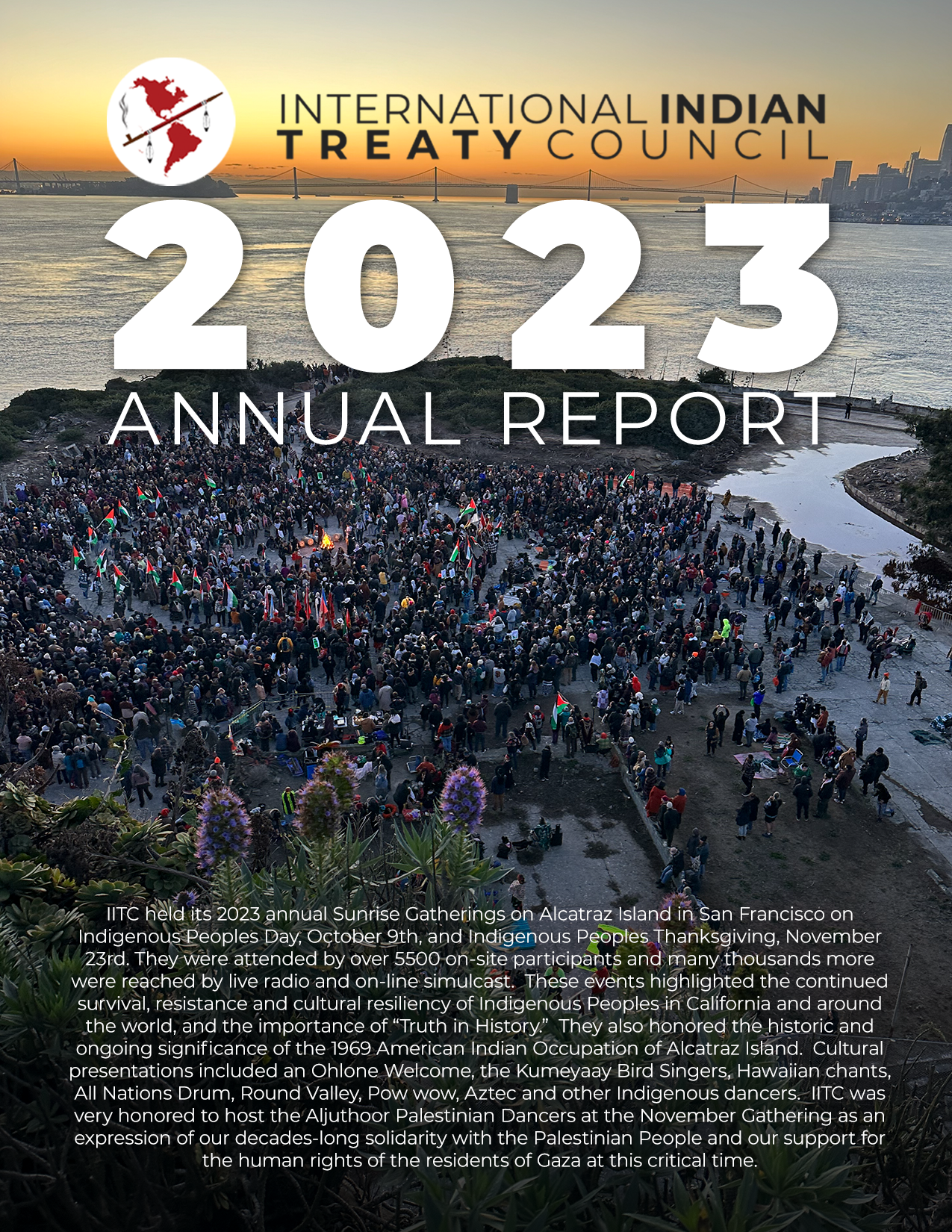
33rd annual Alcatraz Sunrise Gathering, November 22nd 2007 (PDF 209K)

FINAL REPORT FROM THE INDIGENOUS PEOPLES’ BORDER SUMMIT OF THE AMERICAS II SAN XAVIER DISTRICT TOHONO O’ODHAM NATION NOVEMBER 7-10, 2007

Live Web Casts from the Indigenous Peoples’ Border Summit II, San Xavier, Arizona November 7 – 10, 2007

PUBLIC FORUM, Local Indigenous Environmental and Sacred Sites Issues, Saturday, November 17 U of A College of Law, Tucson AZ

Report of the Special Rapporteur on the Right to Food to UN Human Rights Council and General Assembly , May 2007 (see page 44 on Indigenous Peoples in California and Alaska, USA) PDF 243K

Alberta Chiefs of Treaty 6, 7 & 8 Express Disappointment Re: Canadian Federal Government "Throne Speech", October 19th 2007 (PDF 50K)

AGROQUIMICOS: LA AMENAZA A NUESTRA SALUD COMUNITARIA Y AL MEDIO AMBIENTE/ Pesticides: The Threat to our Community Health and the Environment, AHOME, SINALOA, Mexico, Octubre 26 - 28 2007, October 26 – 28, 2007 (PSD 52K)

IITC Training Manual for filing “Shadow Reports” for the review of the United States by the UN Committee on the Elimination of All Forms of Racial Discrimination (CERD), October 17th, 2007 (PDF 578K)

IITC Human Rights Training Novmeber 8th 2007, during the Indigenous Peoples’ Border Rights Summitt II, San Xavier Arizona! (PDF 79K)

UN Declaration for the Rights of Indigenous Peoples adopted by the UN General Assembly September 13th, 2007!

UN Declaration on the Rights of Indigenous Peoples as adopted by the UN General Assembly September 13th 2007 (PDF 56k)

Declaracion de las Naciones Unidas sobre los derechos de los Pueblos Indigenas, adoptada por la Asemblea General el 13 de septiembre de 2007 (PDF 60K) 

IITC Statement on the Adoption of the Declaration on the Rights of Indigenous Peoples, September 16th 2007 (PDF 200K)

US Statement against the adoption of the Declaration on the Rights of Indigenous Peoples, September 13th 2007 (PDF 53K)

CSD 15th session, 2007, April 30 - May 11, 2007

Link for the COMMITTEE FOR THE ELIMINATION OF RACIAL DISCRIMINATION, Seventieth session, 19 February – 9 March 2007,  Concluding observations re: CANADA/ COMITÉ PARA LA ELIMINACIÓN DE LA DISCRIMINACIÓN RACIAL, Septuagésimo período de sesiones, 19 de febrero – 9 de marzo de 2007,  Observaciones finales sobre CANADA

Appointment of Indigenous UNPFII members (2008-2010) announced, April 20, 2007

Treaty Council News Winter 2007 (PDF 1MB)

IITC Submission to the UN High Commissioner on Human Rights for her study on the Human Right to Water, April 15th, 2007 (PDF 136k)

Pesticides are Poison” booklet now available online

Los Plaguicidas son Venenos” manual ahora disponible en internet

UN Web page, Indigenous Peoples and Treaties, the UN Treaty Study Expert Seminars