
(Published November 30, 2000) Six Alaskans are traveling to South Africa this week to make sure the rest of the world knows that toxic chemicals that aren't made in Alaska accumulate here -- in the air, water and subsistence foods.
The group -- three government representatives and three Alaska Natives -- will observe and testify at the final round of talks on an international treaty to phase out 12 of the planet's worst poisons, known as the dirty dozen. The talks will be from Dec. 3 through Dec. 9 in Johannesburg, with the goal of producing a signed treaty by May.
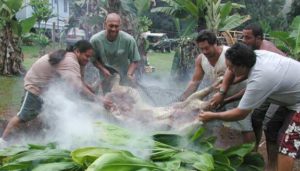
The chemicals to be eliminated include DDT, PCBs, dioxins and other industrial compounds known to cause cancer, reproductive problems and a weakening of the immune system. Some of those contaminants have been found in fish and other subsistence foods.
The Alaska delegates won't be able to vote but want to encourage the U.S. government team to lobby for a strong treaty. The State Department has said the U.S. negotiators are committed to an aggressive treaty and to finding a way to finance the elimination of the chemicals, but the Alaska group is concerned the U.S. team may back down on several key points.
Alaska has a big stake in the outcome because "persistent organic pollutants," as the chemicals are called, tend to travel long distances through the air and water and concentrate in the Arctic, where they take longer to break down because of the cold.
"We end up the recipients of these chemicals," said Michele Brown, commissioner of the Department of Environmental Conservation. Brown is going to South Africa as a state observer, along Jim Ayers, chief of staff to Gov. Tony Knowles, and Will Mayo, the governor's adviser on Native issues.
"The governor feels very strongly about this," Brown said. "If the most harmful chemicals are coming at us internationally, we have to make our voices heard."
Although many Western countries have banned the chemicals, other countries continue to produce and use them. One example is DDT, which is still widely used in central Africa to prevent malaria.
Alaskans want to ensure the treaty allows additional chemicals to be banned in the future. They are concerned about key definitions, such as how long a chemical has to stick around in the environment to be classified as a "persistent organic pollutant."
Pam Miller, executive director of the Alaska Community Action on Toxics, argues for a shorter time. Miller is not going to South Africa but her group is helping to pay for three Alaska Native representatives to go. They are Shawna Larson of Port Graham and Chickaloon, Violet Yeaton of Port Graham and Evon Peter of Arctic Village.
Miller said she sees the treaty as an "unprecedented opportunity to stop the northward flow of chemicals."
As many as 121 countries will participate in the talks. The United States is sending at least 30 official delegates.
At a strategy session in Anchorage on Tuesday, Brown explained to the nongovernmental representatives that the state delegates will not be able to publicly voice a position that goes against the U.S. position until the negotiations are over.
"You won't see us publicly disagreeing with the U.S. until it's over, unless it all goes fine," she said.
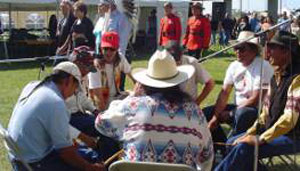
But they can try to persuade the official treaty delegates. The Native members, for instance, are carrying with them a sheaf of resolutions from Alaska Native and American Indian tribes.
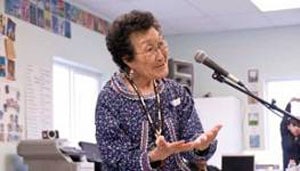
Larson said she hopes to raise awareness about the importance of subsistence foods to Alaska Natives. "We need to shine the spotlight on the U.S. team," to make sure they support a treaty that protects Alaska, she said.
Reporter Elizabeth Manning can be reached at [email protected] or at 907-257-4323.
Distributed by: Indigenous Environmental Network P.O. Box 485 Bemidji, Minnesota 56619-0485 USA Phone (218) 751-4967 Fax (218) 751-0561 email: [email protected] Internet Web Site: www.alphacdc.com/ien
"An alliance of Indigenous Peoples empowering Indigenous Nations and communities towards sustainable livelihoods, environmental protection of our lands, water, air and maintaining the Sacred Fire of our traditions."